E-SERVICES
Ministry of ICT Launches Campaign to Tackle Uganda’s Growing E-Waste Challenges
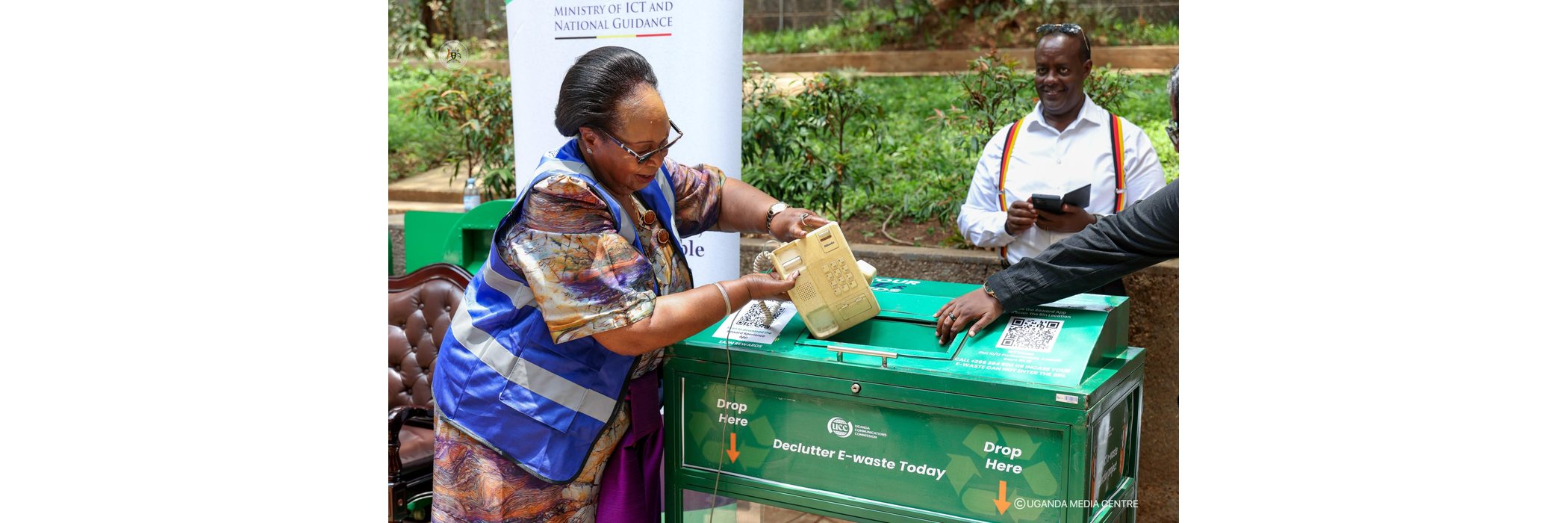
The Ministry of ICT and National Guidance has today, 25th September 2026, launched an e-waste Sensitisation, Cleaning, Collection, Reuse and Responsible Disposal campaign aimed at tackling Uganda’s growing e-waste concerns in a function involving stakeholders from Uganda Communications Commission (UCC), Uganda Media Centre (UMC), ICT Innovation Hub Nakawa, Vas Consults and Towa Uchafu Na Nusu (TUNN) at the Ministry’s Office.
This effort follows the 6-month ICT e-waste collection pilot project rolled out in August 2025, which targeted discarded consumer gadgets like phones and other electronics. Through this pilot, 20 specialised e-waste collection bins were permanently set up nationwide, and 3,270 kilogrammes of electronic gadgets were formally collected and digitally tracked. In addition, another 6,000 kilogrammes were successfully mapped and identified moving through informal repair and recycling channels.
Speaking at the launch, Owekitiibwa Hon. Joyce Nabbosa Ssebugwawo weighed in on the Ministry’s implementation of the digital transformation roadmap and the challenge it creates in generating e-waste that must be managed sustainably.
“As the use of technology grows, so does the amount of electronic equipment that reaches the end of its useful life,” she said. She also added that “Electronic equipment cannot be treated as ordinary waste because some of it can harm people if disposed of inappropriately through dumping carelessly or burning.”
She also said that a smarter Uganda requires responsible use and disposal of technology. By repairing and refurbishing some of these technologies, she envisioned creating job opportunities for technicians and young people, before rounding out her speech with a call to keep the campaign going beyond a one-day event.
Hon. Alioni Yorke Odria, the Minister of State for National Guidance, applauded the initiative for aligning with the National Cleaning Days activity, which happens every last Saturday of the month from 7:00 AM to 10:00 AM. He also noted that Uganda can save between 150-200 billion shillings annually through monthly cleaning, and that Article 17 of Uganda’s Constitution mandates citizens to maintain and ensure a clean environment.
Also in attendance was Dr Aminah Zawedde, the Ministry’s Permanent Secretary, who walked participants through the astronomical costs of collecting, segregating, and properly disposing of ICT e-waste and called for a concerted effort from all concerned entities. “Waste is dirty, but investing in e-waste management is expensive. That is why we are adopting a whole-of-government approach, and we call upon all agencies that if resources are there, let us pool them together for this purpose,” she urged.
Engineer Rebecca Mukite, the Head of Communications and Infrastructure Services at UCC, was also present and shared the great strides that the government of Uganda is making in tackling e-waste concerns. One of these, she said, was public awareness campaigns to educate people to sort e-waste and drop it in collection bins countrywide.
Additionally, she discussed innovations in the pipeline to manage e-waste properly, such as a chatbot set to be ready by October 14th and accessible to smartphone users to locate the nearest e-waste bin, as well as the USSD Code (197).
To reiterate what would make the public awareness campaigns a success, Mr Mundua Patrick, Commissioner, Electronic Services Department at the Ministry, emphasised implementing the 4Rs: reduce e-waste by buying genuine ICT equipment, repair broken-down equipment, reuse valuable components, and recycle e-waste where possible.
The Ministry of ICT said the initiative will continue monthly, on the last Friday of each month. This will go a long way in offsetting the approximately 41 million kilograms of e-waste generated by Uganda, according to statistics from the International Telecommunication Union. The launch brought together Staff from the Ministry, UCC, UMC, Vas Consults, TUNN and the ICT Innovation Hub, Nakawa.
This effort follows the 6-month ICT e-waste collection pilot project rolled out in August 2025, which targeted discarded consumer gadgets like phones and other electronics. Through this pilot, 20 specialised e-waste collection bins were permanently set up nationwide, and 3,270 kilogrammes of electronic gadgets were formally collected and digitally tracked. In addition, another 6,000 kilogrammes were successfully mapped and identified moving through informal repair and recycling channels.
Speaking at the launch, Owekitiibwa Hon. Joyce Nabbosa Ssebugwawo weighed in on the Ministry’s implementation of the digital transformation roadmap and the challenge it creates in generating e-waste that must be managed sustainably.
“As the use of technology grows, so does the amount of electronic equipment that reaches the end of its useful life,” she said. She also added that “Electronic equipment cannot be treated as ordinary waste because some of it can harm people if disposed of inappropriately through dumping carelessly or burning.”
She also said that a smarter Uganda requires responsible use and disposal of technology. By repairing and refurbishing some of these technologies, she envisioned creating job opportunities for technicians and young people, before rounding out her speech with a call to keep the campaign going beyond a one-day event.
Hon. Alioni Yorke Odria, the Minister of State for National Guidance, applauded the initiative for aligning with the National Cleaning Days activity, which happens every last Saturday of the month from 7:00 AM to 10:00 AM. He also noted that Uganda can save between 150-200 billion shillings annually through monthly cleaning, and that Article 17 of Uganda’s Constitution mandates citizens to maintain and ensure a clean environment.
Also in attendance was Dr Aminah Zawedde, the Ministry’s Permanent Secretary, who walked participants through the astronomical costs of collecting, segregating, and properly disposing of ICT e-waste and called for a concerted effort from all concerned entities. “Waste is dirty, but investing in e-waste management is expensive. That is why we are adopting a whole-of-government approach, and we call upon all agencies that if resources are there, let us pool them together for this purpose,” she urged.
Engineer Rebecca Mukite, the Head of Communications and Infrastructure Services at UCC, was also present and shared the great strides that the government of Uganda is making in tackling e-waste concerns. One of these, she said, was public awareness campaigns to educate people to sort e-waste and drop it in collection bins countrywide.
Additionally, she discussed innovations in the pipeline to manage e-waste properly, such as a chatbot set to be ready by October 14th and accessible to smartphone users to locate the nearest e-waste bin, as well as the USSD Code (197).
To reiterate what would make the public awareness campaigns a success, Mr Mundua Patrick, Commissioner, Electronic Services Department at the Ministry, emphasised implementing the 4Rs: reduce e-waste by buying genuine ICT equipment, repair broken-down equipment, reuse valuable components, and recycle e-waste where possible.
The Ministry of ICT said the initiative will continue monthly, on the last Friday of each month. This will go a long way in offsetting the approximately 41 million kilograms of e-waste generated by Uganda, according to statistics from the International Telecommunication Union. The launch brought together Staff from the Ministry, UCC, UMC, Vas Consults, TUNN and the ICT Innovation Hub, Nakawa.
The author is a Communications Officer at the Ministry of ICT & National Guidance.